For a long time, I didn’t really think about ghee much.
It was just one of those things that existed in the kitchen. A jar near the stove. A spoonful on dal when someone in the house felt like the food was looking a little too dry. Ghee on hot rotis. A bit mixed into khichdi when somebody wasn’t feeling well.
Then somewhere along the way, things got confusing.
First, fat became the enemy. Suddenly, everything had to be low-fat, fat-free or somehow lighter than what our parents and grandparents had been eating for years. Ghee was one of the first things people started avoiding.
Now the pendulum has swung the other way.
Scroll through health content for ten minutes and you will probably find somebody telling you to eat ghee every morning. Someone else will say it improves digestion. Another person will claim it helps skin, immunity, weight loss and just about everything else.
Honestly, I don’t think either extreme is particularly useful.
Ghee isn’t something to be scared of. But it isn’t a magic health potion either.
Used in a sensible amount, it can fit comfortably into a normal diet. It adds fat and energy to food, makes simple meals taste better and can be part of the way we enjoy traditional Indian food. The important part, at least from my perspective, is not asking whether ghee is “good” or “bad.”
It’s asking how much of it you are eating, what the rest of your diet looks like and whether you actually need more of it.
That is the same approach we like at Organic Foods India. Good traditional food deserves a place in modern eating, but it doesn’t need exaggerated promises to justify that place.
So instead of listing twenty dramatic ghee benefits, let’s talk about five things that actually make sense in everyday life.
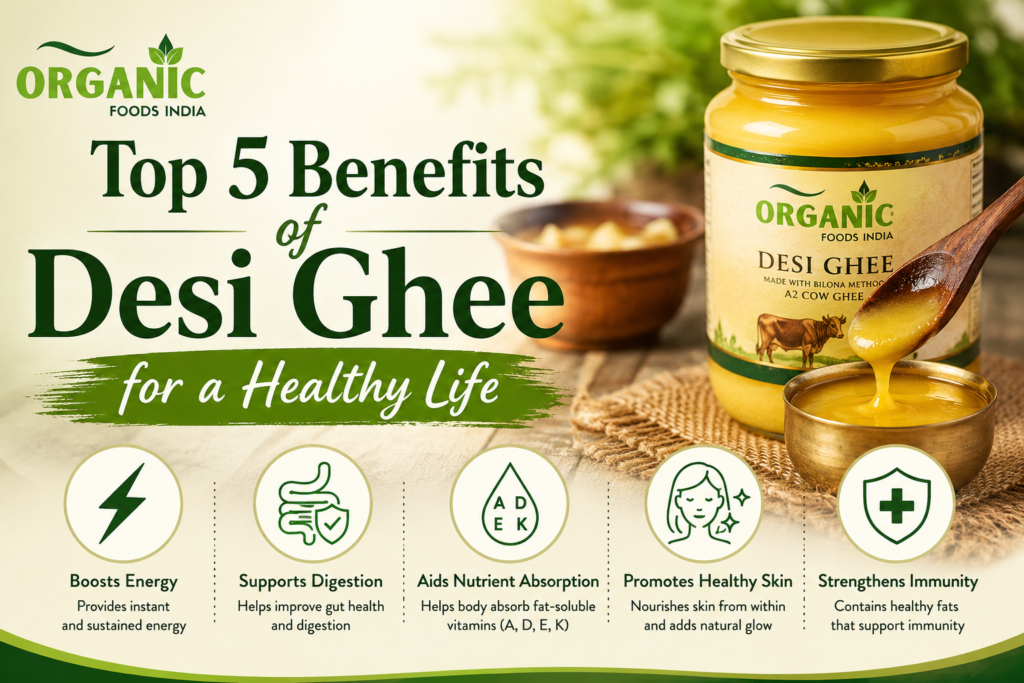
1. Ghee Gives You Energy, Whether You Notice It or Not
This is probably the most straightforward of all the desi ghee benefits.
Ghee is concentrated fat. And fat provides energy.
That sounds almost too obvious to mention, but a lot of the confusion around ghee starts when people forget that it is still a calorie-dense food. You don’t need a huge quantity of it to add quite a bit of energy to a meal.
For someone doing physically demanding work, training regularly or simply eating a diet that requires more calories, that can actually be useful. A little ghee mixed into dal or rice adds richness without making you eat a massive amount of extra food.
But then there is the other side of it.
If your entire day is mostly sitting at a desk, driving around and then sitting in front of the television, your energy needs may not be the same.
And this is where I think people sometimes get carried away.
They hear that ghee is traditional or natural and assume there is no reason to worry about quantity. But “natural” and “unlimited” are two completely different things.
The World Health Organization’s guidance on healthy diets makes a similar point in a broader way. Fat is an important part of the diet, but both the type and amount of fat matter. WHO also recommends keeping saturated fat below 10% of total energy intake.
That doesn’t mean you need to start calculating every drop of ghee you eat.
Personally, I think that would make eating unnecessarily stressful.
It just means a spoon of ghee should be seen as part of your total food intake, not as some health supplement that doesn’t count because it came from a traditional kitchen.
I usually notice the difference most with simple food. Dal-chawal without any fat can feel a bit plain. Add a small spoon of ghee, and suddenly the same meal feels richer and more filling.
For me, that’s enough.
I don’t really see the point of adding four more spoons just because somebody on the internet said more ghee equals more health.
2. One of the More Useful Ghee Benefits Is How It Fits Into a Balanced Meal
This one is less flashy, which is probably why it doesn’t get talked about as much.
Our body needs dietary fat for several normal functions. Fat is also involved in the absorption of fat-soluble vitamins, including vitamins A, D, E and K.
You can read more about the role of these nutrients in the National Library of Medicine’s overview of fat-soluble vitamins.
Now, that doesn’t mean you should start adding ghee to every vegetable dish because otherwise your body won’t get anything from it.
That’s not the point.
The point is simply that fat has a role in a balanced diet. A meal made entirely of dry carbohydrates and vegetables doesn’t suddenly become “healthier” just because you removed every possible source of fat.
This is one reason traditional Indian meals make sense to me when you look at the whole plate rather than one ingredient.
You might have dal, some sabzi, roti or rice, perhaps curd, and a little fat used in cooking or added at the end.
Nobody needs to turn that into a complicated nutrition experiment.
A small amount of ghee can simply be part of the meal.
And honestly, this is how I prefer using it.
Not as something I eat separately in the morning because somebody claimed it will detox my body. Just in actual food.
A little on khichdi.
Sometimes mixed into dal.
Sometimes on a hot roti.
The food tastes better, and that’s usually reason enough.
3. Ghee Can Make Simple Food Feel Like an Actual Meal
This may sound like a strange health benefit, but hear me out.
Food satisfaction matters.
We’ve all eaten those meals that technically had everything they were supposed to have but somehow still left us wandering around the kitchen forty minutes later looking for biscuits.
Sometimes the issue isn’t hunger exactly.
The meal just wasn’t satisfying.
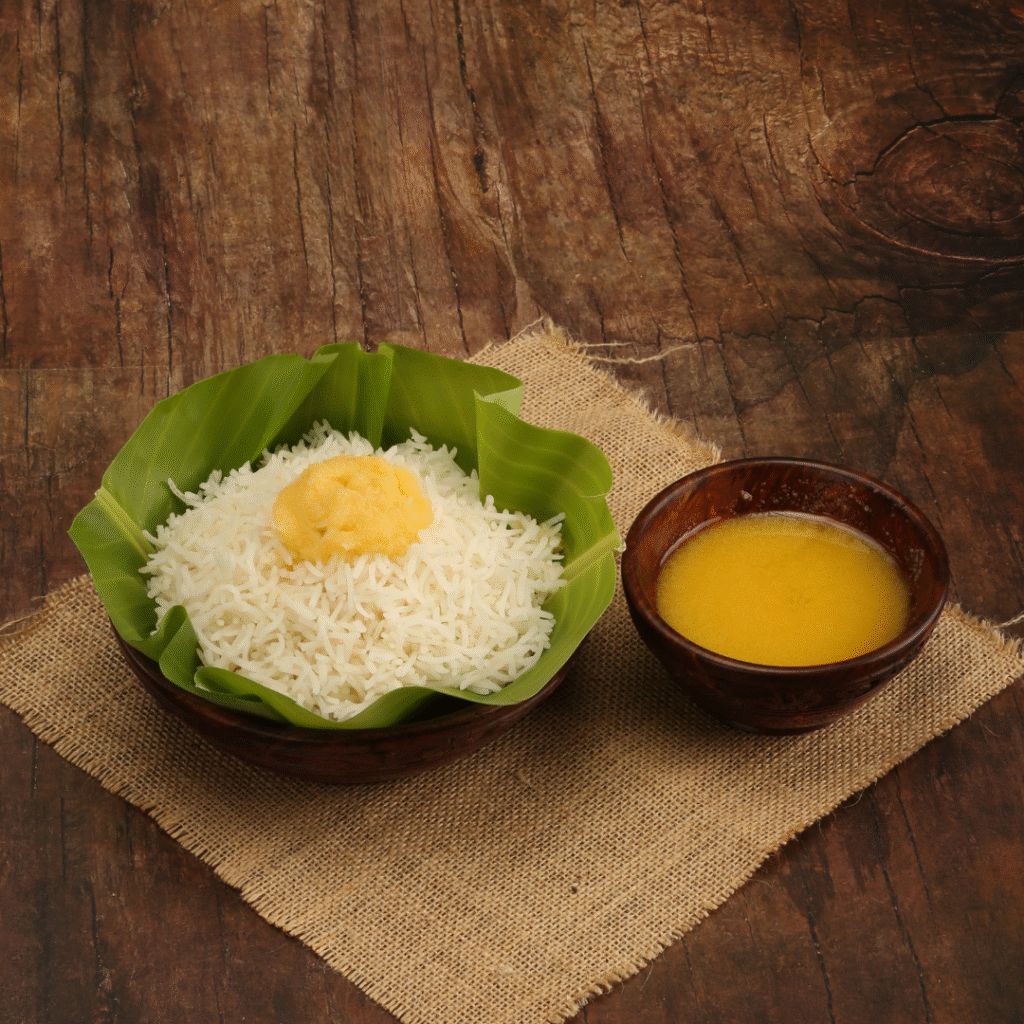
Ghee can help with that because fat changes the texture, aroma and overall experience of food. Plain rice becomes softer and richer. Dal gets that familiar flavour. Khichdi stops feeling like something you are eating only because you have a bad stomach.
One of the ghee benefits I personally appreciate most is simply this: you often don’t need much.
A small spoon can change the entire bowl.
And because you are using a concentrated fat, “a little” really should mean a little.
The ICMR-NIN Dietary Guidelines for Indians discuss visible fats as part of the overall diet rather than treating any single fat source in isolation. That makes sense in real life too.
Let’s say you had parathas for breakfast, fried snacks in the afternoon and a creamy curry at lunch.
Adding several spoons of ghee at dinner just because you read about desi ghee benefits is probably missing the bigger picture.
But if the rest of your meals are fairly balanced, using a modest amount of ghee is a completely different situation.
I think this is where nutrition advice often becomes annoying.
People want one exact answer.
“How many spoons?”
“Is it healthy or unhealthy?”
“Should I eat it every day?”
But food doesn’t really work that neatly.
Your day matters.
Your activity level matters.
Everything else on your plate matters.
4. Ghee Benefits for Skin Are More Complicated Than Social Media Makes Them Look
Let’s be honest. The topic of ghee benefits for skin has become slightly ridiculous online.
I’ve seen claims that eating ghee gives you glowing skin almost immediately. I’ve also seen people recommend putting it directly on the face as though it works for every skin type and every problem.
Maybe some people have personal experiences they like. That’s fine.
But I wouldn’t treat ghee as a skincare solution.
Your skin doesn’t exist separately from the rest of your lifestyle.
Sleep affects it. Sun exposure affects it. Stress can affect it. Hydration, overall nutrition and individual skin conditions can all matter too.
So when someone asks me about ghee benefits for skin, my answer is a little boring.
Ghee can be one part of a balanced diet that includes dietary fat. But eating ghee alone is not a replacement for eating properly.
The WHO’s healthy diet recommendations recommend at least 400 grams of fruits and vegetables per day for people aged 10 and above.
That is the kind of number I find more useful to think about.
Are you eating enough variety?
Do you get fruits and vegetables regularly?
Are you getting enough protein?
Or are you eating a teaspoon of ghee every morning while living mostly on packaged snacks and hoping the ghee somehow balances everything out?
I used to be guilty of expecting individual foods to do too much.
Not just ghee. Some “superfood” every few months.
Eventually, I realised the boring answer was probably the correct one. Your overall routine matters more.
These days, I see ghee as one small part of food. Nothing more dramatic than that.
5. Cow Ghee Benefits and Buffalo Ghee Benefits: Which One Should You Choose?
This question comes up a lot because people tend to want a clear winner.
Cow ghee versus buffalo ghee.
Which one is healthier?
Which gives more benefits?
Which one should you buy?
The honest answer is that the choice is often more complicated than the marketing around it.
Cow Ghee Benefits
When people talk about cow ghee benefits, they often mention its lighter feel, aroma and its popularity in traditional Indian cooking.
Cow ghee has a distinct flavour that works particularly well with dal, rotis, rice and everyday meals. A lot of people simply prefer the taste.
And taste matters.
If you’re buying a product you’re actually going to use regularly, there’s nothing wrong with choosing one because you enjoy it more.
But I wouldn’t claim that switching to cow ghee automatically transforms your health.
It is still a source of dairy fat and saturated fat. Quality matters. Quantity matters. The rest of your diet matters.
That’s really the recurring theme here.
Buffalo Ghee Benefits
Buffalo ghee benefits are often discussed differently because buffalo ghee tends to have a richer, heavier character.
The flavour can feel more intense and creamy, which is why some people prefer it for certain dishes or sweets.
Personally, I think this often comes down to what you grew up eating.
Some households swear by cow ghee. Others prefer buffalo ghee and find cow ghee too light.
Neither preference needs a complicated scientific argument.
Both can be used as part of a balanced diet.
The main thing I would avoid is believing that one allows unlimited consumption while the other requires caution. The WHO’s recommendations on saturated fat still apply to the overall diet.
If you are already eating plenty of foods high in saturated fat, adding large amounts of any type of ghee may not be the smartest approach.
On the other hand, a modest amount used with otherwise balanced meals is a much more reasonable picture.
So, How Much Ghee Should You Actually Eat?
I wish there were a simple answer that worked for everyone.
There isn’t.
Your ideal amount depends on how active you are, how much food you eat, what other fats are already in your diet and what your individual health needs look like.
For me, a small spoon is generally enough.
Sometimes I use less.
There are days when I don’t add ghee at all because I’ve already eaten something heavier.
I don’t follow a strict “one teaspoon every day at exactly this time” rule. That feels unnecessarily rigid.
Instead, I try to pay attention to the full day.
If breakfast was already rich, maybe lunch doesn’t need extra fat.
If I’m eating something very plain like khichdi, a little ghee makes sense.
This is also much easier to maintain than following internet rules that don’t take your lifestyle into account.
The ICMR-NIN Dietary Guidelines for Indians are useful here because they look at food as part of an overall dietary pattern rather than declaring one ingredient good or bad on its own.
And if you already have a health condition or have been advised to control your saturated fat or calorie intake, personalised advice from a qualified healthcare professional is obviously more useful than copying somebody else’s morning routine.
What I Personally Look for When Buying Desi Ghee
I’ve become a little picky about ghee over time.
The first thing I notice is the aroma.
Good ghee should smell pleasant and rich. Not artificial. Not strangely flat.
Then comes the ingredient list.
I prefer knowing exactly what I’m buying instead of relying entirely on words printed in large letters on the front of a jar.
“Pure.”
“Traditional.”
“Natural.”
Those words sound good, but I still like checking the actual product information.
At Organic Foods India, that’s also the approach we prefer: know your food, check where it comes from and don’t choose something solely because the label promises ten unbelievable health benefits.
And once you have good ghee, don’t overcomplicate storage either.
Keep the container clean and dry. Avoid getting moisture into it. Store it properly according to the product instructions.
Simple things usually work best.
Frequently Asked Questions
Is it okay to eat ghee every day?
For many people, a modest amount of ghee can fit into a balanced diet. The important thing is to consider your total calorie intake and how much saturated fat you are getting from other foods.
What are the biggest desi ghee benefits?
Ghee provides dietary fat and energy, can make meals more satisfying and can be included as part of a balanced eating pattern.
Are there real ghee benefits for skin?
Ghee should not be treated as a miracle skincare food. Good overall nutrition, hydration, sleep and other lifestyle factors play a much bigger role.
What is the difference between cow ghee and buffalo ghee?
They differ in the type of milk used and can vary in taste, texture and richness. The better choice often depends on your preference and how you plan to use it.
The Bottom Line
The funny thing about ghee is that people have managed to make it far more complicated than it needs to be.
For generations, it was simply food.
Then it became “bad fat.”
Now, in some corners of the internet, it has become almost magical.
I think the middle ground is much more useful.
The real ghee benefits don’t come from taking huge amounts every morning or expecting one ingredient to fix your entire lifestyle. They come from using it as part of a normal, balanced way of eating.
Enjoy the taste.
Choose quality.
Keep an eye on quantity.
And don’t forget about everything else on your plate.
Whether you prefer cow ghee or buffalo ghee, whether you add it to dal, roti or khichdi, the basic idea remains the same.
A small amount can go a long way.
And honestly, that’s probably how ghee has survived in Indian kitchens for so long in the first place.
Not because anyone thought it was a miracle.
Just because good food, used with a little common sense, has always had a way of sticking around.