
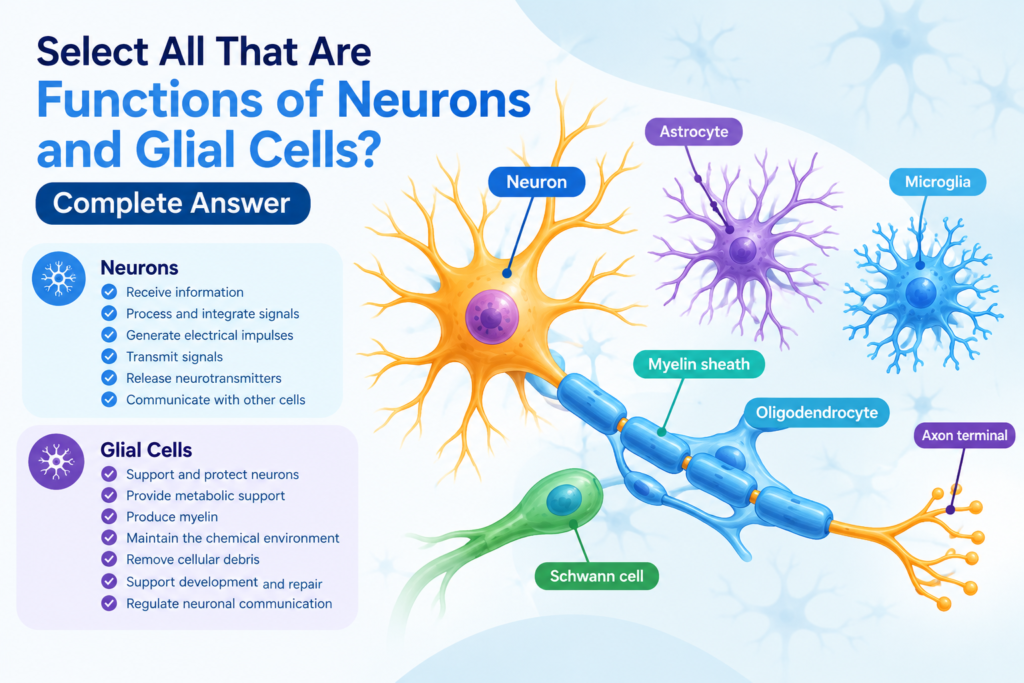
If you are searching for “select all that are functions of neurons and glial cells,” you are likely trying to identify which functions belong to neurons, which belong to glial cells, and which functions are shared between these two major cell groups of the nervous system.
The short answer is:
Neurons receive, process, and transmit information through electrical and chemical signals. Glial cells support, protect, nourish, insulate, and regulate neurons while also contributing to communication within nervous tissue.
According to OpenStax, neurons are specialized cells capable of receiving and transmitting chemical or electrical signals, while glial cells perform several support and regulatory functions that complement neuronal activity.
Quick Answer: Functions of Neurons and Glial Cells
If this is a “select all that apply” question, the following are important functions to remember.
Functions of neurons
- Receiving information from other cells
- Processing and integrating signals
- Generating electrical impulses
- Transmitting information to other cells
- Releasing neurotransmitters
- Communicating with muscles, glands, and other neurons
Functions of glial cells
- Supporting neurons
- Protecting neurons
- Providing nutrients and metabolic support
- Producing myelin
- Maintaining the chemical environment around neurons
- Removing cellular debris and pathogens
- Supporting neuronal development and repair
- Regulating aspects of neuronal and synaptic communication
These functions are supported by educational and biomedical sources, including OpenStax and the National Institutes of Health.
What Are Neurons?
Neurons are specialized cells responsible for communication within the nervous system.
Think of a neuron as a biological communication system. It receives information, processes that information, and passes a signal to another cell.
Neurons have specialized structures that make this possible.
Dendrites
Dendrites generally receive signals from other neurons or sensory receptors. These signals move toward the cell body.
Cell body
The cell body, or soma, contains the nucleus and other structures required to keep the neuron functioning. It also participates in integrating incoming signals.
Axon
The axon carries an electrical signal away from the cell body toward the axon terminals.
Axon terminals
At the end of the axon, the electrical signal can trigger the release of chemical messengers called neurotransmitters. These neurotransmitters cross the synapse and communicate with another neuron or target cell. NIH explains that electrical signals can be converted into chemical signals at the axon terminal and then transmitted across the synapse.
What Are the Main Functions of Neurons?
1. Receiving information
One of the primary functions of a neuron is to receive information.
Dendrites can receive signals from neighboring neurons, sensory receptors, or other cells. The neuron then processes these incoming signals to determine its response.
For example, sensory neurons can receive information associated with touch, temperature, pressure, or pain.
2. Processing and integrating information
Neurons do more than simply pass messages along.
They integrate signals arriving from multiple sources. If the appropriate conditions are met, the neuron can generate an electrical impulse known as an action potential.
OpenStax describes the axon hillock as an important site where signals from multiple synapses are integrated before an electrical signal travels along the axon.
3. Generating electrical signals
Neurons are electrically active cells.
When a neuron reaches the appropriate threshold, changes in the electrical state of its membrane produce an action potential. This electrical signal can travel along the axon.
This process allows information to move rapidly through neural networks.
4. Transmitting information
Neurons transmit information to other neurons and target cells.
At the end of an axon, neurotransmitters can be released into a synaptic space. These chemical messengers then influence the next cell.
This communication system allows the nervous system to coordinate movement, sensation, thought, memory, and many automatic body functions.
5. Communicating with muscles and glands
Neurons do not communicate only with other neurons.
Some neurons communicate with muscle cells and glands. This enables the nervous system to influence movement and other physiological processes.
The NIH explains that networks of communicating neurons and glia help different parts of the brain and nervous system work together to control functions such as movement, thinking, behavior, breathing, and other activities.
What Are Glial Cells?
Glial cells, or glia, are non-neuronal cells that perform a wide range of functions that help the nervous system operate properly.
Older descriptions sometimes presented glial cells as little more than structural “support cells.” Modern neuroscience gives them a much broader role.
OpenStax explains that glial cells help maintain the neuronal environment, provide myelin, support developing neurons, and participate in regulating communication between nerve cells.
NIH also identifies several glial functions, including supporting and protecting neurons, creating myelin, helping repair neurons, removing dead cells, and regulating neurotransmitters.
What Are the Main Functions of Glial Cells?
1. Supporting neurons
Glial cells provide structural and functional support that neurons need.
Neurons operate within a highly controlled environment. Glial cells help maintain that environment so neurons can communicate effectively.
2. Protecting neurons
Certain glial cells contribute to the defense and maintenance of nervous tissue.
For example, microglia act as immune-related cells within the central nervous system. They can remove cellular debris and respond to potential threats.
OpenStax identifies microglia as cells involved in scavenging dead cells and protecting the brain from invading microorganisms.
3. Producing myelin
One of the best-known functions of glial cells is producing myelin.
Myelin forms an insulating layer around certain axons. This insulation helps electrical signals travel efficiently.
Different glial cells perform this function in different parts of the nervous system. Oligodendrocytes produce myelin in the central nervous system, while Schwann cells produce myelin in the peripheral nervous system.
4. Maintaining the chemical environment
Neurons are sensitive to changes in their surrounding environment.
Astrocytes help regulate ions and chemicals in the extracellular environment around neurons. This is essential because appropriate concentrations of ions and neurotransmitters are important for normal neuronal signaling.
Research published through PubMed also describes glial roles in maintaining ionic and water homeostasis and modulating neuronal function and signaling.
5. Providing nutrients and metabolic support
Some glial cells interact closely with neurons and blood vessels to help provide metabolic support.
For example, astrocytes make contact with both neurons and capillaries and can provide nutrients and other substances to neurons.
6. Supporting neuronal development
Glial cells also contribute to nervous-system development.
Certain glial cells help guide developing neurons to appropriate locations and support the development of neural connections.
This means glia are important not only for maintaining the mature nervous system but also for helping build it during development.
7. Regulating neuronal communication
Glial cells can influence communication between neurons.
Research summarized in a peer-reviewed review article shows that glia can modulate synaptic function, synapse formation and elimination, metabolism, blood flow, and neuronal signaling.
This is one reason modern neuroscience no longer views glial cells as merely passive structural support.
Neurons vs. Glial Cells: What Is the Difference?
| Function | Neurons | Glial Cells |
|---|---|---|
| Receive signals | Yes | Can influence signaling but not their primary classic role |
| Generate electrical signals | Yes | Generally not their primary function |
| Transmit neural information | Yes | Support and modulate this process |
| Release neurotransmitters | Yes | Some glial signaling roles are recognized |
| Provide structural support | Limited | Yes |
| Produce myelin | No | Yes |
| Protect nervous tissue | Limited/directly context-dependent | Yes |
| Maintain extracellular environment | Limited | Yes |
| Remove cellular debris | No | Yes, especially microglia |
| Support neuronal development | Indirect | Yes |
| Provide metabolic support | Not the primary role | Yes |
The distinction is useful, but it should not be treated as absolute. Research has shown that glial cells can actively influence neuronal signaling and synaptic activity.
Types of Glial Cells and Their Functions
There are several major types of glial cells, and each performs specialized functions.
Astrocytes
Astrocytes are found in the central nervous system. They provide structural and metabolic support, help regulate the extracellular environment, and participate in the organization and regulation of synapses.
They also contribute to the blood-brain barrier.
Oligodendrocytes
Oligodendrocytes produce myelin around axons in the central nervous system.
A single oligodendrocyte can contribute myelin to multiple axons.
Microglia
Microglia are immune-related cells of the central nervous system.
They help remove damaged or dead cellular material and participate in responses to threats within nervous tissue.
Schwann cells
Schwann cells are found in the peripheral nervous system and produce myelin around peripheral axons.
Satellite cells
Satellite glial cells are associated with neurons in peripheral nervous system ganglia and provide structural and metabolic support.
Ependymal cells
Ependymal cells line fluid-filled spaces in the brain and spinal cord and are associated with cerebrospinal fluid production and circulation.
Are Neurons and Glial Cells Both Important?
Yes.
It is inaccurate to think of the nervous system as being made up of neurons alone.
Neurons provide the primary rapid communication network, while glial cells help create the conditions in which that network can function.
OpenStax describes the nervous system as consisting of neurons and glia, with neurons specialized for chemical and electrical signaling and glia performing complementary support and regulatory roles.
A useful way to remember the relationship is:
Neurons communicate. Glial cells support, protect, regulate, and maintain the environment that makes communication possible.
However, modern research has made this distinction more nuanced because glial cells can also actively influence neuronal signaling.
Select All That Apply: Functions of Neurons and Glial Cells
If you are answering a multiple-choice or “select all that apply” question, remember the following.
Functions associated primarily with neurons:
✓ Receive information
✓ Integrate incoming signals
✓ Generate electrical impulses
✓ Transmit electrical signals
✓ Release neurotransmitters
✓ Communicate with other neurons
✓ Communicate with muscles and glands
Functions associated primarily with glial cells:
✓ Support neurons
✓ Protect neurons
✓ Produce myelin
✓ Maintain the extracellular environment
✓ Provide metabolic support
✓ Remove cellular debris
✓ Support neuronal development
✓ Regulate aspects of neurotransmission
✓ Participate in repair and responses to injury
Not every glial cell performs every one of these functions. Glial cells are a diverse group, and their roles depend on their type and location.
Why Do Neurons Need Glial Cells?
Neurons require a carefully controlled environment to communicate effectively.
Glial cells help maintain that environment in several ways. They provide metabolic support, regulate extracellular ions and chemicals, form myelin, remove damaged material, and interact with synapses.
This relationship is not simply a matter of one cell type “working” and another cell type “supporting.” Research has demonstrated extensive communication between neurons and glia, including effects on synaptic transmission and information processing.
That cooperation is essential to the normal functioning of the nervous system.
Frequently Asked Questions
What is the main function of neurons?
The primary function of neurons is to receive, process, and transmit information using electrical and chemical signals.
What is the main function of glial cells?
Glial cells perform many functions, including supporting and protecting neurons, producing myelin, maintaining the neuronal environment, providing metabolic support, and regulating aspects of neural communication.
Do glial cells transmit signals?
Glial cells are not traditionally classified as the primary signal-transmitting cells of the nervous system. However, research shows that some glial cells can actively influence neuronal and synaptic signaling.
Which cells produce myelin?
In the central nervous system, oligodendrocytes produce myelin. In the peripheral nervous system, Schwann cells produce myelin.
Are glial cells more than support cells?
Yes. Modern research shows that glial cells perform diverse functions beyond structural support, including regulating the neuronal environment, influencing synapses, supporting metabolism, producing myelin, and participating in immune responses.
Final Answer
The best way to answer “Select all that are functions of neurons and glial cells” is to separate their major roles.
Neurons: receive information, integrate signals, generate electrical impulses, transmit information, and communicate with other cells.
Glial cells: support and protect neurons, provide metabolic support, produce myelin, maintain the extracellular environment, remove cellular debris, support development and repair, and regulate aspects of neuronal communication.
Together, neurons and glial cells form a highly coordinated system. Neurons provide much of the nervous system’s rapid communication, while glial cells create and maintain the environment that allows those signals to work effectively.
Understanding this distinction makes questions about neurons and glial cells much easier—not only for exams, but also for understanding how the nervous system functions as a whole.